When every cupboard, corner, and clear floor space matters, clutter can make a small home feel smaller than it is. The best small apartment storage hacks do more than hide belongings: they make everyday items easier to reach without blocking walkways or turning a room into a wall of bins.
This guide covers vertical storage, overlooked spaces, and multi functional furniture that can earn its footprint in US and UK homes. You’ll find practical product-style picks, their drawbacks, and simple checks to make before buying. Measure carefully, check local product dimensions, and choose storage that suits what you actually own.
Small Apartment Storage Hacks Start With Vertical Space
In a compact home, the floor is valuable real estate. Moving storage upward can free up room for walking, cleaning, and daily activities, provided shelves are stable and items remain easy to reach. Vertical organizing solutions work particularly well for books, folded linens, pantry goods, and objects you use often but do not need on the counter.
Start by looking at the wall space above a desk, beside a doorway, or over a low cabinet. Before drilling, check what is behind the wall and use fixings suited to its construction. A shelf loaded with books is much heavier than an empty shelf, so follow the product’s installation instructions and stated load limits. In rented homes, confirm what alterations are allowed and consider freestanding options where drilling is restricted.
Pick 1: A modular cube shelf
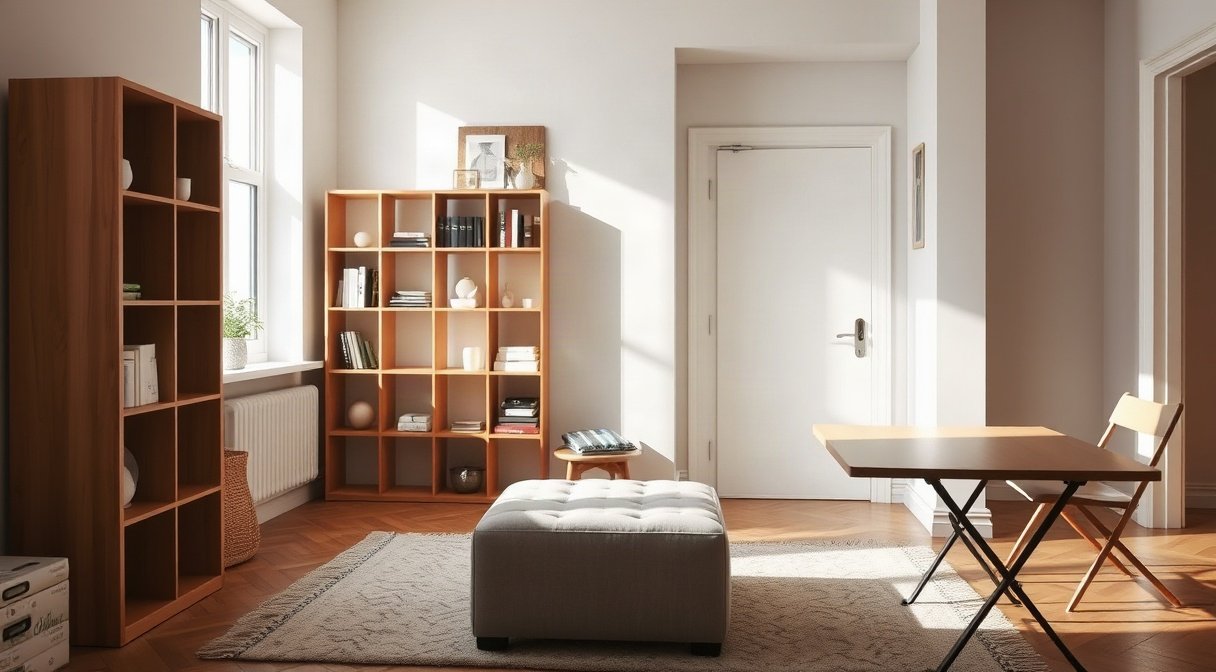
A cube unit such as IKEA KALLAX can act as a bookcase, a room divider, or a base for baskets. Its open compartments make it easy to sort belongings by category, and fabric or woven inserts can soften a busy-looking display. Used as a divider, it can suggest separate living and sleeping zones without building a wall.
- Good at: Providing flexible, visible storage for books, hobby supplies, and baskets.
- Trade-off: Open cubes collect dust, and large units take up substantial floor area. Inserts may make frequently used items less convenient to retrieve.
- Better alternative for: Anyone short on floor space or needing closed storage; consider a narrower wall-mounted shelf or a tall cabinet that fits the available footprint.
Do not assume a cube shelf is safe as a divider simply because it stands upright. Secure it as the manufacturer directs, especially in homes with children or pets. The US Consumer Product Safety Commission’s furniture tip-over guidance explains why anchoring tall or unstable furniture matters. UK households should also follow the product maker’s fixing instructions and use suitable wall hardware.
Pick 2: Wall-mounted shelves with a ledge
A shallow shelf or picture ledge can hold small framed art, a few paperbacks, or toiletries without using the depth of a cabinet. This is a useful choice above a desk, beside a bed, or in a narrow hall. Choose a ledge with a lip when you want to keep small objects from sliding off, and avoid loading a decorative shelf beyond its stated capacity.
The limitation is that wall shelves demand accurate installation and do not conceal clutter. They are also less useful for bulky objects and may not suit walls where drilling is prohibited. For renters, a tall, slim bookcase can offer a similar upward-storage benefit while staying freestanding, although it still needs tip-over protection where recommended.
For a balanced result, combine closed and open storage rather than filling every wall. Put attractive or frequently used things on display, and keep visual clutter behind doors or in baskets. These small apartment storage hacks work best when the shelves follow a routine: assign each shelf a category, label baskets if helpful, and leave a little spare space so the arrangement remains usable.
Small Apartment Storage Hacks for Doors, Beds, and Awkward Gaps
Some of the most useful storage opportunities are already built into a room. The back of a door, the area beneath a bed, and the gap beside a refrigerator can all hold belongings that otherwise spill into living space. These solutions are usually less expensive and less disruptive than adding a large cabinet, but they only help when the stored items remain accessible.
Before buying, measure the full opening or clearance, not just the apparent empty space. Include door trim, handles, skirting boards, bed frames, and the room needed to pull a container out. In US homes, check inch dimensions and door thickness; in UK listings, confirm centimetres and the maximum door clearance. Product photos can disguise how far an organiser protrudes into a narrow passage.
Pick 3: An over-door organiser
An over-door rack with pockets or hooks can store accessories, cleaning supplies, or toiletries without requiring a new cabinet. A pocket design is handy for small, lightweight items; a rack with hooks may suit coats or bags. It can be moved more easily than a drilled shelf, making it attractive for renters and people who expect to rearrange soon.
- Good at: Using the back of a door for light items that need to stay visible and close at hand.
- Trade-off: Some designs stop the door from closing fully, and pockets can sag when overloaded. The rack may also scratch a finish or clash with door trim.
- Better alternative for: Heavy tools, glass bottles, or doors that must close tightly; use a properly secured cabinet or a freestanding organiser instead.
Test the door with the organiser in place before filling it. Check that it opens freely and that the top hooks do not press hard against the door. Keep heavier items low, distribute weight evenly, and do not hang anything that could fall onto a person or pet.
Pick 4: Under-bed drawers or low rolling bins
Under-bed storage is well suited to spare bedding, seasonal clothing, and shoes used less often. Drawers on casters are easier to access than lidded boxes when the bed has enough clearance. If dust is a concern, choose a covered container; if you need frequent access, a low open bin may be simpler.
The catch is that some bed frames offer very little usable clearance, and deep bins can be awkward to pull from a tight room. Measure from the floor to the lowest obstruction, including a central support rail. Consider the mattress height and the path between the bed and a wall, too. A container that technically fits may still be impossible to remove once the room is furnished.
Store only clean, dry belongings under the bed, and avoid compressing delicate fabrics for long periods. If dampness is a concern, especially in a basement flat or a poorly ventilated room, use sealed containers and inspect stored items occasionally. Do not block a bed’s ventilation or any heating equipment with boxes.
Use narrow gaps without making them hard to clean
A slim rolling cart can make use of a gap beside a washing machine, desk, or kitchen cabinet. It is useful for bottles, craft materials, or pantry items, but the gap must be wide enough for the cart and its handle. Wheels that lock help prevent unwanted movement. Avoid placing a cart where it obstructs appliance ventilation, plumbing access, or an emergency route.
These small apartment storage hacks are most effective when they store items that belong nearby. Keep laundry supplies by the washer, spare sheets near the bedroom, and everyday toiletries near the bathroom. Moving possessions to an inconvenient location may technically clear a surface, but it often leads to clutter returning. Choose a container that is easy to pull out, easy to clean, and sized for a specific category rather than a vague promise to “organise everything.”
Multi Functional Furniture That Earns Its Footprint
Furniture that performs two jobs can reduce the number of items a compact room needs. A storage ottoman can serve as a footrest and a place to stow blankets; a gateleg table can open for meals and fold down afterward. The best multi functional furniture is not simply clever. It works comfortably in each mode, is easy to switch between uses, and does not require moving half the room to reach its storage.
Think about how often you will use each function. A bed with drawers may be worthwhile if you need regular access to spare clothes. A lift-top coffee table may suit someone who often eats or works from the sofa. A convertible guest bed might be a smart choice for a host, but poor value for a household that rarely has visitors. The more frequently a mechanism moves, the more important stable construction and straightforward operation become.
Pick 5: A storage ottoman or bench
An upholstered ottoman with a lift-up lid can provide seating, a footrest, and hidden storage for throws or toys. A longer bench may fit at the end of a bed or along an entry wall, while a compact cube can tuck beside a sofa. Look for a lid that opens smoothly and a usable interior size; thick upholstery can make the storage cavity smaller than the outer dimensions suggest.
- Good at: Hiding soft, low-weight items while offering an extra seat or footrest.
- Trade-off: The lid can be inconvenient if the ottoman is crowded by other furniture. Some models are not designed for regular adult seating or heavy loads.
- Better alternative for: Anyone needing a sturdy daily-use chair, easy access to stored items, or a surface that will not be covered by cushions and blankets.
Check the manufacturer’s stated seating and weight limits rather than judging by appearance. A soft-sided option can be lighter and easier to move, but may not be as durable as a rigid frame. For a hallway bench, confirm that the depth leaves enough room to open the front door and pass safely.
Pick 6: A gateleg or drop-leaf dining table
A gateleg table can expand for meals or projects and fold down when the extra surface is not needed. IKEA NORDEN is one familiar example of the style, with hinged leaves that can be raised or lowered. This format can work well in a kitchen-diner or studio where a permanent full-size table would crowd the walkway.
The compromise is that a folded table may still occupy meaningful floor area, and the open position needs room for chairs on the sides people actually use. Hinges and supports should feel secure, and the table should not wobble during normal use. Measure the table both open and folded, then mark those dimensions on the floor with removable tape before ordering.
Skip a folding table if your household needs a full-size dining surface throughout the day or if the folding mechanism would be awkward for the person using it. A wall-mounted drop-leaf table can save more floor space, but it requires suitable wall fixing and may not be allowed in a rental. A simple small table may be the more practical option when it already fits without blocking circulation.
Pick 7: A lift-top coffee table
A lift-top table can raise a work or eating surface toward the sofa and often hides a storage compartment below. This is a useful option for people who do laptop tasks at home and lack space for a separate desk. Some designs also have lower shelves for remotes or books, keeping everyday objects near the sofa.
Be realistic about the downsides: a lift mechanism adds weight and moving parts, and the raised top can make the sofa area feel crowded. Check whether the lid opens safely, whether the raised surface is stable, and whether the table can still be reached from the seating position. It is not an ideal replacement for an ergonomic desk used for full workdays. A lightweight nesting table may suit someone who only needs occasional extra surface space.
Among multi functional furniture, the strongest choice is the one that replaces an item you already need, rather than adding a new feature you may rarely use. Check the footprint, interior storage dimensions, assembly requirements, and return policy before deciding. If a piece is difficult to convert, it can quickly become a fixed obstacle instead of a flexible solution.
Small Apartment Storage Hacks for Kitchens, Bathrooms, and Entryways
High-traffic areas often become clutter hotspots because they handle the daily flow of food, coats, shoes, toiletries, and cleaning supplies. Small apartment storage hacks in these rooms should prioritise safe access and quick routines, not just maximum capacity. Keep the items you use most often within easy reach, and store occasional-use belongings higher or farther away.
In a kitchen, a tiered shelf inside a cupboard can make two levels from one, while a narrow organiser can make a small pantry easier to scan. Use hooks for lightweight tools only where they will not interfere with cooking or cabinet doors. In a bathroom, a shower caddy or over-cabinet basket can make use of vertical space, but it should not obstruct taps, ventilation, or access to cleaning surfaces.
Pantry and cabinet organisers
A shelf riser can bring tins and jars at the back into view. A turntable can help reach condiments in a deep cupboard, while clear, stackable containers can make dry goods easier to identify. Choose a container size based on the food you buy and the shelf height you have, rather than decanting everything into a mismatched set that wastes space.
- Good at: Making existing shelves easier to use and reducing the number of items hidden behind others.
- Trade-off: Organisers take up some of the space they save. Turntables can be unstable with tall bottles, and containers need labels and cleaning.
- Better alternative for: Very small cupboards or households that buy varied package sizes; adjustable shelves or simple grouped baskets may be more flexible.
Do not store heavy glass jars on an unstable riser or stack containers beyond their design. Keep food away from cleaning products, and follow local food-storage guidance. A clear container is only useful if it seals properly and makes contents identifiable, so retain package information or label the container with its contents and relevant dates.
Bathroom storage without a permanent renovation
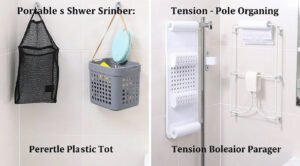
A slim freestanding bathroom trolley can fit beside a vanity, while a tension-pole caddy can add shelves in a shower without drilling. These can be useful for toiletries and spare towels, but check the material and finish for a damp environment. Ventilate the room and let wet items dry rather than sealing moisture into a basket or cabinet.
Freestanding trolleys may roll or tip if overloaded, and tension poles may slip if fitted incorrectly or used on unsuitable surfaces. Follow the installation instructions and keep heavy bottles on lower shelves. If there is not enough clearance to use a trolley comfortably, a shallow wall shelf or a small cabinet may be a better fit—provided it can be installed securely.
Entryway storage that keeps the route clear
A narrow shoe rack, a few wall hooks, and a small tray for keys can reduce the pile-up near an entrance. Choose a shoe rack that matches the number of pairs normally kept at the door, rather than the maximum number the household owns. Store out-of-season footwear elsewhere so the entryway stays passable.
A wall-mounted hook rail uses vertical space, but coats and bags can project into the walkway. A bench with shoe storage can combine seating and organisation, yet its depth may narrow a hall. Measure the door swing and clear walking route before ordering. For a very narrow entrance, a single row of hooks and a compact shoe tray might work better than a bulky hall tree.
For any tall cabinet, shelf, or rack, use the included anti-tip hardware when the maker recommends it and anchor to a suitable surface. If you are unsure which fixing is appropriate, consult the furniture maker or a qualified installer rather than guessing. UK residents can also check product safety guidance from recognised consumer bodies; US residents can consult the CPSC. Good storage should improve access without creating a tipping, tripping, or fire-exit hazard.
How to Choose and Arrange Storage That Fits Your Home
Good planning prevents the most common storage mistake: buying an attractive organiser that does not fit the space or the way you live. Start with a quick inventory. Group belongings by category, note which items are used daily or weekly, and identify what can be donated, recycled, or stored elsewhere. There is little benefit in purchasing a larger cabinet to organise things you no longer need.
Measure the available space in three dimensions, including height, width, and depth. Then note obstacles such as skirting boards, radiator pipes, window handles, power outlets, and door swings. Leave room to open drawers and cupboard doors fully. If ordering online, compare the assembled dimensions with the delivery route: a large item may fit its intended corner but not the stairwell or lift.
Use a simple fit-and-function checklist
- Define the job: Decide what the storage needs to hold and where those items are used.
- Choose access: Use open shelves for frequently reached belongings and closed storage for visual calm or dust protection.
- Check stability: Review the weight limit, assembly method, wall-fixing requirements, and care instructions.
- Protect circulation: Preserve clear paths, door access, and safe access to windows and equipment.
- Plan maintenance: Pick surfaces and containers you can clean easily, especially in kitchens and bathrooms.
Sketch the room or use masking tape to mark the proposed furniture footprint. This is a simple way to check whether a new shelf blocks a route or whether a table can open without hitting a sofa. When space is especially tight, test the largest moving part as well as the closed footprint: pull out the bed drawer, open the table leaf, or raise the coffee-table top.
Consider visual weight as well as measurements. One tall, closed cabinet may look calmer than several small open shelves, but it can dominate a tiny room. Light-coloured finishes and open legs can make some furniture appear less bulky, although function and durability should come first. Keep a consistent set of baskets or storage boxes to make open shelving look more orderly without hiding everything.
Before you buy, compare alternatives by use rather than by a feature list. A wall shelf may be cheaper and narrower than a bookcase but requires installation. A storage bed might replace a dresser, yet accessing the compartment could be inconvenient every day. A folding table saves space when closed but may not be stable enough for heavy work. Product details and manufacturer instructions are more useful than a lifestyle photograph when deciding whether an item matches your needs.
For installation, follow the maker’s documentation and use suitable fixings for the wall type. The UK’s Approved Document A guidance on structural safety is a useful official reference for building structure, though it is not a substitute for product-specific installation advice. In the US, consult the relevant local requirements where a project involves structural changes. If you are uncertain about a wall, load, or fitting, ask a qualified professional.
Finally, treat organising as a repeatable routine rather than a one-off makeover. Give each item a home close to where it is used, return it after use, and review crowded storage occasionally. If a basket is always overflowing, the answer may be fewer belongings or a better category system, not another bin. These small apartment storage hacks are most successful when they make the everyday version of your home easier to maintain.
FAQ: Small Apartment Storage Hacks and Furniture
What are the best small apartment storage hacks for renters?
Begin with freestanding shelves, under-bed containers, over-door organisers, and furniture with built-in storage. These options can minimise drilling, but still check lease terms and product safety instructions. A tall freestanding unit may need anti-tip protection, so ask the landlord about approved fixing methods rather than leaving it unsecured.
How can I add storage without making a small room feel crowded?
Use the wall height selectively, choose furniture with a modest footprint, and avoid filling every open surface. Combine a few closed containers with open shelves, and keep walkways clear. Before purchasing, mark the furniture dimensions on the floor and check the space needed to open drawers or folding parts.
Is vertical storage better than buying a larger cabinet?
Not always. Vertical organizing solutions are useful when floor area is limited and the wall can safely support the installation. A closed cabinet can be a better choice for bulky belongings, visual calm, or dust protection. Compare the available footprint, wall construction, access needs, and fixing requirements before choosing.
Which multi functional furniture is most useful in a studio flat?
A storage ottoman, a folding dining table, or a lift-top coffee table can be useful depending on how you use the room. Choose the piece that replaces a separate item you genuinely need. Check stability, usable storage dimensions, and the amount of space required when the furniture is fully open.
What should I avoid storing under a bed?
Avoid putting damp, dirty, or delicate belongings into an unventilated container for long periods. Do not block heating equipment or interfere with the bed frame’s ventilation. Measure the clearance and choose containers that can be removed easily, then inspect stored items from time to time.
How do I make storage furniture safer?
Assemble items according to the manufacturer’s instructions, observe load limits, and use the specified anti-tip hardware where required. Put heavier objects on lower shelves and keep walkways clear. If you are unsure about the correct wall fixing or the condition of a wall, get advice from a qualified installer.
Conclusion: Choose Storage That Makes Daily Life Easier
The most useful small apartment storage hacks make belongings easier to find while preserving room to move. Start with vertical space and overlooked gaps, then consider multi functional furniture that replaces a piece you already need. Measure before buying, check installation and weight guidance, and be honest about each product’s drawbacks. A few carefully chosen solutions—and a simple routine for using them—can make a compact home feel more organised without crowding it.
Compare the ideas with your room measurements, choose one high-impact change, and build from there. For more practical home-product recommendations, explore our roundup of useful Amazon product picks and our robot vacuum and mop combo review.