Cookware claims can be confusing: “non-toxic,” “green,” and “chemical-free” sound reassuring, but they do not explain what a pan is made of or how it performs. The best non toxic cookware set for your kitchen depends on the cooking surfaces you want, the care you can manage, and the documentation a manufacturer provides—not just a label on a box.
This guide compares common cookware materials, explains how to evaluate coatings, and weighs the strengths and drawbacks of representative options. You will also find practical guidance on ceramic pan safety, how to assess PFAS free pots claims, and what to check before buying a full set.
What “Non-Toxic” Cookware Means—and What It Does Not
“Non-toxic cookware” is a useful shopping phrase, but it is not a single regulated material category or a universal guarantee that a product contains no chemicals. Every physical material is made of chemicals. A more meaningful question is whether the cooking surface is suitable for its intended use, whether it can withstand the temperatures and care instructions you will follow, and whether the maker clearly identifies its materials.
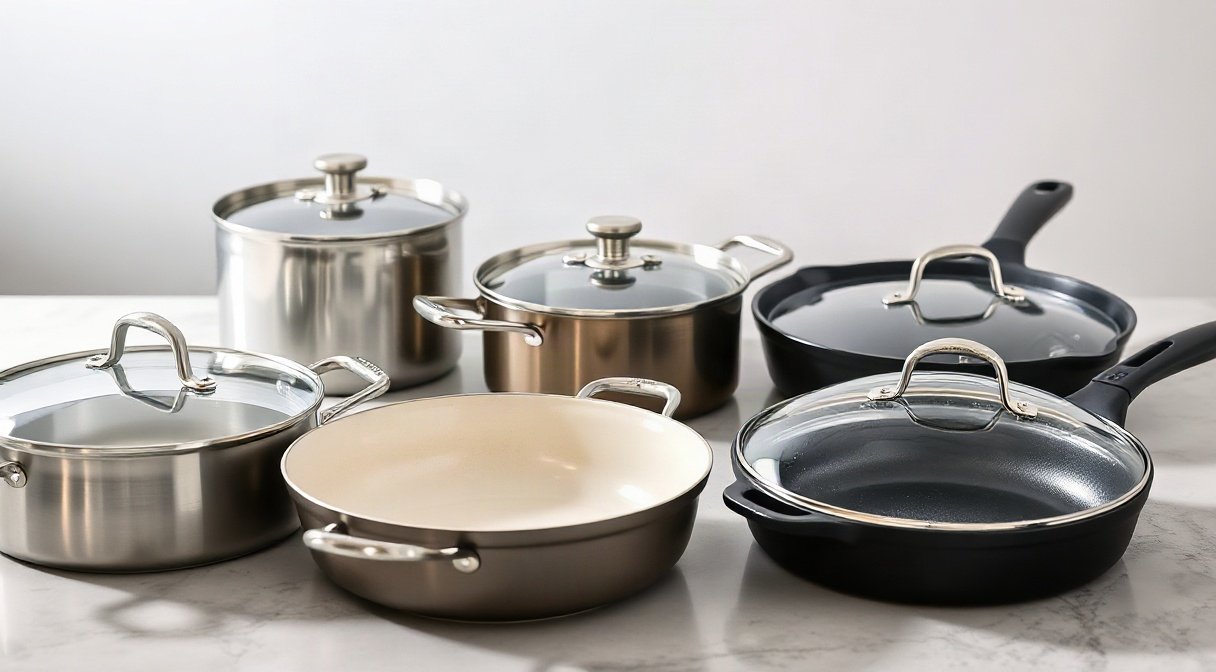
Start by separating the pan’s body from its cooking surface. A stainless-steel skillet may have an aluminum or copper core for heat distribution, while stainless steel touches the food. A ceramic-coated pan may have an aluminum body under a thin sol-gel coating. A cast-iron pan has a metal body, often with a seasoned surface. The words “ceramic,” “stone,” or “granite” on packaging do not necessarily mean the pan is made entirely from that material.
For shoppers concerned about persistent chemicals, PFAS is an important term to understand. Some traditional nonstick coatings use fluoropolymers, including PTFE, which belongs to the broad PFAS family. Product formulations and terminology vary, so look for a clear, product-specific statement about the coating rather than assuming that “PFOA-free” means “PFAS-free.” A PFOA-free claim addresses one substance; it does not, by itself, establish that a product contains no other PFAS.
Government sources can help you distinguish broad environmental concerns from cookware-specific claims. The EPA’s overview of PFAS explains the wider category and why these substances receive scrutiny. For food-contact materials, consult the FDA’s information on food-contact substances. These resources do not certify a particular pan as “non-toxic”; they provide context for evaluating materials and manufacturer documentation.
In practice, a cautious buyer looks for an identified cooking surface, clear temperature and care limits, and a manufacturer that answers reasonable questions. Ask whether the nonstick layer contains PTFE or other fluorinated chemistry if that matters to you. Check whether claims apply to the exact model and every component in a set, including lids and accessories.
- Prefer specifics: named materials and written care instructions are more useful than broad wellness language.
- Check the whole set: a set can combine different materials and coatings across pieces.
- Match the claim to your concern: “PFOA-free,” “PFAS-free,” and “PTFE-free” do not mean the same thing.
- Remember use matters: following heat limits and replacing damaged cookware can reduce avoidable wear.
The best non toxic cookware set is therefore not necessarily the one with the most reassuring marketing. It is the one whose materials you understand, whose limitations suit your cooking, and whose maker provides enough information to make an informed choice.
Compare Cookware Materials Before Choosing a Set
Material determines more than a product’s chemical profile. It affects browning, heat response, weight, cleanup, maintenance, and compatibility with your cooktop. Before comparing complete sets, decide which tasks you do most: searing, simmering, delicate eggs, acidic sauces, or quick weeknight cooking. There is no single material that excels at every job, so some cooks build a small mix rather than buying a matching set.
| Material | Useful strengths | Trade-offs | Best suited to |
|---|---|---|---|
| Stainless steel | Durable, handles browning, usually tolerates metal utensils | Food can stick; technique and preheating matter | Searing, sauces, everyday versatility |
| Cast iron | Excellent heat retention; can last for years with care | Heavy; requires drying and seasoning or enamel care | High-heat cooking, roasting, and steady heat |
| Carbon steel | Responsive, relatively light for a pan, develops seasoning | Needs seasoning; acidic foods can be challenging | Stir-frying, searing, and cooks who maintain pans |
| Sol-gel ceramic-coated | Easy-release cooking when new; straightforward cleanup | Coating wears; heat and utensil limits matter | Eggs and lower-fat cooking with gentle use |
| Traditional ceramic | Nonmetal cooking surface; often oven- and microwave-friendly, depending on item | Can be heavy or breakable; heat response differs by product | Baking, serving, and certain stovetop designs |
Stainless steel is a strong foundation for a durable kitchen. Look for a securely bonded construction and a base suited to your cooktop; fully clad designs commonly distribute heat up the sides, while disc-bottom designs concentrate construction at the base. Stainless steel is not naturally nonstick, so cooking with appropriate preheating and enough fat helps. People who want effortless release for eggs may prefer a separate coated skillet instead of expecting a steel set to behave like one.
Cast iron and carbon steel offer long service potential, but neither is a no-maintenance choice. Bare iron needs prompt drying and a maintained seasoning layer. Enamel-coated cast iron avoids routine seasoning, although its enamel can chip if mishandled and it is usually heavy. These options suit cooks who value heat retention and do not mind extra care; they are a poor match for someone seeking lightweight pans and quick, carefree cleanup.
“Ceramic cookware” needs closer inspection. It may describe a ceramic-like nonstick coating applied to metal, or a vessel made from ceramic material throughout. Those are different products with different heat limits and handling needs. For ceramic pan safety, follow the maker’s temperature guidance, avoid heating an empty coated pan for an extended period, and do not use a chipped or flaking surface. A ceramic-style coating can offer easy release, but it is not a lifetime coating.
When weighing PFAS free pots, do not infer material composition from color or a stone-pattern finish. Read the exact model’s materials statement and ask the manufacturer if the coating chemistry is unclear. If you want to avoid nonstick coatings entirely, stainless steel, cast iron, carbon steel, and suitable glass or ceramic vessels are alternatives, each with its own practical compromises.
Think about a set as a collection of tools, not a matched display. A useful combination might be stainless-steel saucepans and stockpot, plus one cast-iron skillet and one small ceramic-coated pan for delicate foods. This can be more versatile—and less wasteful—than acquiring several pieces that duplicate the same job.
Best Non Toxic Cookware Set Options: Strengths and Drawbacks
Product lines change, and a brand’s range may include several constructions or coatings. Treat the following examples as starting points for comparison, not as a blanket endorsement of every item sold under each name. Before ordering, verify the current model’s construction, included pieces, oven limits, cooktop compatibility, and care instructions. A “set” can also vary by retailer, so compare the individual pieces rather than relying on the product-family name alone.
All-Clad D3 Stainless: A durable everyday foundation
Tri-ply stainless-steel cookware such as All-Clad’s D3 range is designed for cooks who want a metal cooking surface and responsive heat distribution. Its strengths are versatility and the ability to build fond for pan sauces; stainless steel can also handle more vigorous utensils than a delicate nonstick finish. It is a reasonable choice for frequent searing, sautéing, and simmering, provided the cook is willing to learn how to prevent sticking.
The downside is that stainless steel demands technique. Eggs and delicate fish can cling, and burnt-on residue may take soaking or scrubbing. A clad set can also feel substantial and may sit in a higher buying tier than basic cookware. It is not the best choice for someone who wants every pan to release food effortlessly, or for a buyer who dislikes polishing and cleaning metal cookware.
Lodge cast iron: Long-lived heat retention
A traditional cast-iron skillet is a practical complement to a cookware set rather than a complete solution for every kitchen task. It retains heat well, works on many cooktops, and can move from stovetop to oven when the specific product’s instructions allow. It is often an accessible way to add a durable cooking surface for searing, cornbread, and other high-heat or oven-finished dishes.
It is heavy, can be awkward to wash, and needs attentive drying to discourage rust. Acidic ingredients may interact with seasoning, particularly in a newer pan or during extended cooking. Someone with limited grip strength, who wants dishwasher convenience, or who cooks mostly quick acidic sauces should consider stainless steel or enamel cookware instead.
GreenPan Valencia Pro and similar ceramic-coated ranges: Easy release with limits
Ceramic-coated aluminum cookware is appealing when easy release and straightforward cleanup are priorities. GreenPan’s Valencia Pro line is one example shoppers may encounter; verify the current product’s stated coating, construction, and use instructions rather than assuming every range is identical. This style can be useful for eggs, pancakes, and lower-fat cooking when used at moderate heat and with nonabrasive tools.
Its weakness is durability of the release performance: the coating can lose its easy-release quality with wear, overheating, abrasive cleaning, or improper use. “Ceramic” in this context does not mean a solid ceramic pan, and it should not be treated as indestructible. Choose another option if you want decades of hard use, frequent high-heat searing, or metal-utensil freedom.
Caraway cookware: Coordinated design and a coated surface
Caraway’s cookware is often considered by buyers who want a coordinated look alongside a ceramic-coated cooking surface. Its visual design and the convenience of a nonstick-style pan may suit a carefully maintained home kitchen. Review the manufacturer’s current material and care information for the exact set, and check whether its included pieces match the way you cook rather than paying for a complete collection by default.
The trade-off is similar to other coated cookware: careful handling is important, and the surface will not be immune to wear. A buyer who uses high heat, stacks pans without protection, or wants to put every piece in the dishwasher may be better served by stainless steel. Do not choose a product on color or wellness language alone; confirm the coating claim that matters to you.
Xtrema-style all-ceramic cookware: A different kind of cooking surface
All-ceramic cookware, including products from makers such as Xtrema, differs from metal pans with a ceramic-like coating. It offers a nonmetal cooking surface and can be useful for specific stovetop, oven, or serving tasks, subject to the product’s instructions. For shoppers prioritizing a surface without a polymer-style nonstick layer, it may be worth comparing.
All-ceramic cookware can be heavier, more fragile, and slower to respond to temperature changes than metal. It may not suit a cook who needs fast heat adjustment, wants a lightweight skillet, or regularly handles pans roughly. Review heat-shock guidance and cooktop compatibility carefully; do not assume that all ceramic vessels are suitable for every burner.
For many households, the best non toxic cookware set is a hybrid collection: stainless steel for most work, one coated pan for low-stick tasks, and cast iron or carbon steel if the cook enjoys maintaining it. If you are also comparing kitchen appliances, our guides to temperature-control electric kettles and home cold-brew coffee makers cover other useful additions.
How to Check Labels, Coatings, and Set Construction
Marketing terms can make two very different pans sound alike. A careful comparison starts with the manufacturer’s product page and care guide, not just the retailer’s headline. Look for a material breakdown for each piece, the type of cooking surface, and any explicit statement about PTFE or PFAS. If the listing says only “healthy nonstick” or “eco-friendly,” treat that as a reason to investigate rather than as proof of a particular chemical profile.
Claims need to be read precisely. “PFOA-free” is not synonymous with “PFAS-free,” and a claim about one substance may not cover every component. “PTFE-free” addresses a particular fluoropolymer but does not tell you everything about the product’s materials. A brand may describe its coating as ceramic-based; ask whether the body is metal and what the coating is made from if that distinction is important to your decision.
Look for documentation that answers practical questions: Can the pan be used on induction? What is the maximum oven temperature, and does that limit include the lid? Is the handle oven-safe? Is the product dishwasher-safe, and does the manufacturer recommend hand washing anyway? Are metal utensils permitted? These details affect whether a set will remain useful, and they can vary even between products from the same brand.
Compare construction and pieces as carefully as coatings. A low-cost set may contain many small items you will rarely use, while a smaller collection may have more substantial pans that fit your routine. Check the diameter and capacity of the skillet and saucepans, the weight of each piece, handle attachment, lid fit, and whether lids are glass or metal. For induction, check the specific product’s compatibility rather than relying on a general claim about the brand.
Use this checklist before buying:
- Identify the cooking surface and body material for every pan.
- Find product-specific PTFE, PFAS, or PFOA statements if those matter to you.
- Read the temperature, utensil, cleaning, and storage instructions.
- Check cooktop compatibility, including induction where relevant.
- Confirm what is included and whether the set’s sizes suit your household.
- Review warranty terms and what the manufacturer says about coating wear.
Be skeptical of absolute phrases such as “chemical-free” or “completely safe.” They are not a substitute for a clear explanation of materials and intended use. A reliable maker should be able to clarify whether a claim applies to a specific line, a specific coating, or every product in the set. If the answer is vague, choose a more transparent option.
The best non toxic cookware set should also fit your cooking behavior. If you commonly preheat pans on high, stack cookware without protection, or rely on the dishwasher, a delicate coated pan may frustrate you even if its material claims meet your preferences. Conversely, a technically durable steel set may not be a satisfying choice if you expect nonstick release without changing your technique.
Care, Everyday Use, and Choosing the Right Combination
Safe, durable cookware depends on both its construction and how it is used. Begin with the manufacturer’s instructions; general advice cannot override a product’s tested temperature limits or cleaning recommendations. Avoid leaving a coated empty pan over strong heat, since excessive heat can damage some surfaces. Use moderate settings unless the recipe and pan guidance call for otherwise, and keep handles positioned securely over the cooktop.
For coated pans, use wooden, silicone, or other approved utensils and avoid scouring pads unless the instructions specifically allow them. Let a hot pan cool before washing, because sudden temperature changes can stress some materials. Hand washing often helps preserve a coating, even when a manufacturer says a pan is dishwasher-safe. Store pans with care: a protector between stacked pieces can help prevent scratches.
For stainless steel, preheating and using enough cooking fat can make release easier. Let food form a crust before trying to turn it, rather than forcing it from the surface. Soak stubborn residue and use a suitable cleaner when needed. For bare cast iron or carbon steel, follow the maker’s seasoning and drying guidance, and avoid putting a wet pan away. Enamel cookware should be handled to reduce impacts that could chip its surface.
When should you replace a pan? Follow the maker’s guidance, and stop using a coated pan if the cooking surface is visibly peeling, flaking, or badly damaged. A scratched pan is not automatically the same as a failed one, but damage can affect performance and may worsen with continued use. Replace cookware when its surface, handle, or base can no longer be used as intended. Do not try to restore a coating with unapproved sprays or home treatments.
Build a set around your actual meals. A household that cooks a lot of pasta, soup, and pan sauces might prioritize a stockpot, medium saucepan, and stainless skillet. Someone who makes eggs most mornings may want one small coated skillet, even if the rest of the cookware is uncoated. A cook who sears meat or bakes in a pan may value cast iron. These combinations can be more functional than an oversized set with duplicate pieces.
Budget by expected lifespan and use rather than by piece count alone. Entry-level options can be sensible if you need a few basics, while higher-end clad steel or specialized cookware may make sense for frequent cooks who value construction and repairability. Do not assume that a more expensive set is safer, and do not assume that a low-cost pan is unsafe solely because it costs less. Verify the materials and warranty, then compare the likely replacement needs.
Ultimately, the best non toxic cookware set is one you can use correctly and maintain without frustration. A focused collection often wins: uncoated metal for high-heat work, a carefully used coated pan for delicate foods, and a pot suited to your usual batch size. Choosing fewer, more appropriate pieces can also reduce the temptation to discard a whole set when one pan wears out.
Frequently Asked Questions
Is ceramic-coated cookware safer than traditional nonstick?
“Ceramic-coated” and “traditional nonstick” describe different coating types, but safety depends on the exact product, its materials, and how it is used. Check the manufacturer’s product-specific disclosures and heat limits. Ceramic-style coatings can wear over time, so avoid overheating and replace a pan with a badly damaged surface.
Are PFAS free pots automatically chemical-free?
No. “PFAS-free” is a claim about a particular group of substances, not a statement that a product contains no chemicals. Cookware is made from materials with chemical components. Confirm what the claim covers, and review the body, coating, and care instructions for the exact model.
Does “PFOA-free” mean a pan is PFAS-free?
No. PFOA is one substance in the broader PFAS category. A PFOA-free statement alone does not establish that a product contains no other PFAS or that it is PTFE-free. Look for precise, current manufacturer documentation if avoiding these materials is a priority.
Which cookware material is best for everyday cooking?
Stainless steel is a versatile starting point for many kitchens because it supports browning and does not depend on a nonstick coating. It does require technique to limit sticking. A mixed collection that adds one easy-release pan may be more convenient than insisting on a single material for every task.
When should I stop using a coated pan?
Follow the manufacturer’s replacement guidance. Stop using a pan if its coating is peeling or flaking, or if the pan is otherwise damaged in a way that affects normal use. Avoid high heat, abrasive tools, and rough stacking to help reduce premature wear.
Should I buy a complete cookware set or individual pieces?
Buy a set if its included sizes and materials match the way you cook and offer useful value as a group. Choose individual pieces if you only need a few pans or want different materials for different jobs. Compare capacities, weights, and care instructions before deciding.
Conclusion: Choose Materials You Understand
Choosing safer cookware is less about finding a perfect label and more about matching a well-documented material to your cooking habits. Compare the cooking surface, confirm product-specific claims, and consider the real trade-offs in cleaning, durability, and heat performance. The best non toxic cookware set may be a carefully chosen mix rather than one matching box. Check the manufacturer’s current details, choose pieces you will use, and follow their care instructions for the long term.