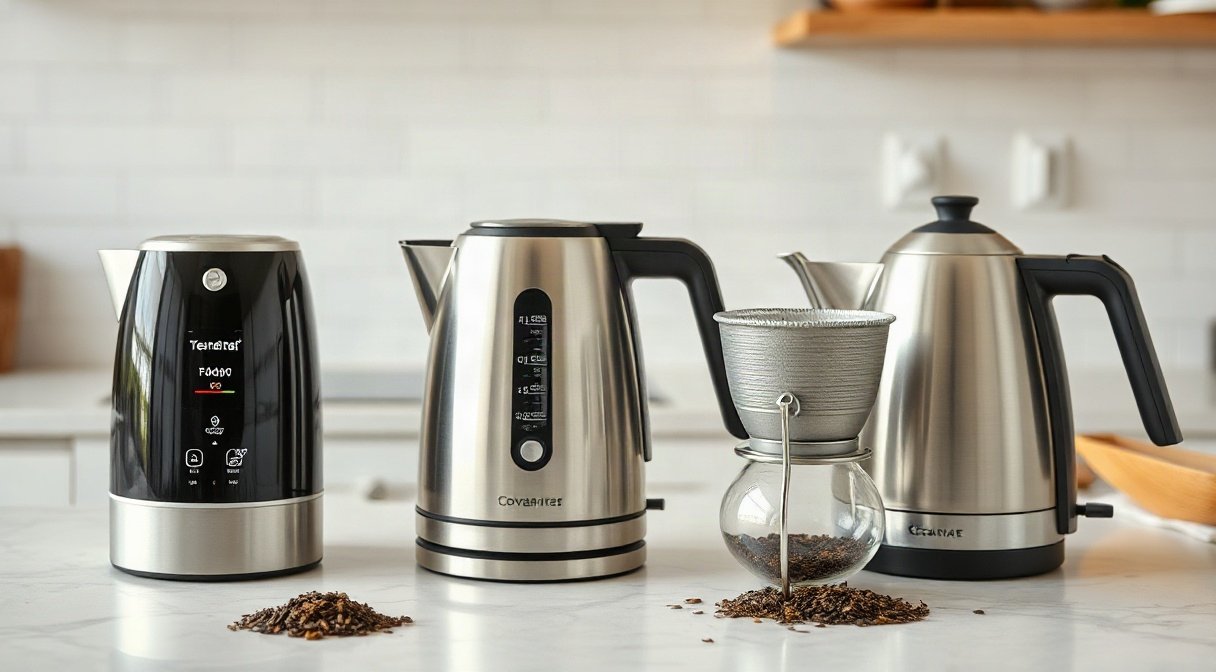
A kettle that boils water is easy to find; one that reliably stops at the temperature your brew needs takes more thought. The best electric kettle temperature control models make it easier to prepare delicate green tea, repeat a favorite coffee recipe, and avoid waiting for freshly boiled water to cool.
This guide compares five options for different kitchens and brewing styles, including gooseneck kettles for a steady pour and larger countertop kettles for serving several people. We weigh temperature settings, pouring control, capacity, ease of use, and drawbacks—not just feature lists—so you can choose a kettle that suits the way you actually brew.
How to Choose the Best Electric Kettle Temperature Control
Start with the drinks you make most often. Pour-over coffee rewards a narrow, controlled stream, so a long gooseneck spout can make a bigger practical difference than a large capacity. Tea drinkers may value clearly labeled presets and a keep-warm function more. If your household makes several cups at once, a wider kettle with more capacity may be worth the trade-off in pouring precision.
Temperature options vary by model. Some kettles offer a handful of preset buttons, while others let you select a target temperature in small increments. More settings are useful if you regularly follow specific recipes; they are less important if you mostly brew black tea and coffee. Remember that displayed temperature and actual water temperature can differ slightly depending on calibration, fill level, and how soon you pour.
For coffee, many brewers start with water in the general neighborhood of 195–205°F, then adjust to taste and their brewing method. Delicate teas often call for cooler water, but the right target depends on the tea and personal preference. These are starting points, not hard rules. A kettle with flexible controls lets you experiment without repeatedly boiling water and leaving it to cool.
- Spout: A gooseneck offers a slower, more directed pour; a standard spout is quicker for filling cups.
- Capacity: Compact kettles suit solo brewing, while larger models are easier for families and guests.
- Hold function: Useful if you brew more than one cup or want water ready for a second steep.
- Controls: Check whether buttons are intuitive and whether the display is easy to read.
- Cleaning: A wide opening helps with descaling and reaching inside to wipe the kettle.
Also consider the counter space and the cord. A base that swivels can be convenient, but it still needs a nearby outlet and a stable surface. Stainless-steel interiors are common; look at the manufacturer’s care instructions rather than assuming every finish or component can be treated the same way.
The best electric kettle temperature control for one person may be a precise, compact gooseneck, while a household may prefer a roomy preset model. To understand a key product’s published functions, compare the Fellow Stagg EKG Pro specifications with your own must-haves. Feature availability can vary by version, so check the exact model listing before buying.
Gooseneck Kettle Pour Over: Two Picks for Controlled Brewing
A gooseneck kettle is designed to give the brewer more control over where and how quickly water leaves the spout. That can help when pouring in stages over a coffee bed, especially if you are practicing a repeatable recipe. It does not make coffee automatically better: grind size, coffee freshness, filter, and technique still matter. These two options suit different budgets and levels of control.
Fellow Stagg EKG Pro: A polished choice for careful brewers
The Stagg EKG Pro is a premium gooseneck kettle aimed at people who enjoy dialing in pour-over routines. Its digital controls allow temperature selection, and the model includes convenience features such as a hold setting and a scheduling option. Fellow’s documentation describes its particular functions and operating details, so check the current product page for the version sold in your region.
- Good at: Precise-feeling control, a steady gooseneck pour, and a considered interface for repeat brewing.
- Less good at: Its specialized shape is slower for filling multiple mugs, and its premium positioning may be hard to justify for occasional tea.
- Buy something else if: You want a large-capacity family kettle, the lowest-cost option, or a simple one-button appliance.
For a dedicated coffee corner, the display and controlled flow can make daily brewing feel consistent and pleasant. The best electric kettle temperature control choice for a hands-on coffee fan may be worth paying more for, but the extra features are not essential to everyone. Confirm the capacity and the exact hold and scheduling functions listed for the model you are considering.
COSORI gooseneck: Useful presets without a luxury feel
COSORI’s electric gooseneck kettle is a more accessible way to get a narrow spout and preset temperature options. Depending on the specific version, it offers several one-touch temperature choices and a keep-warm function. That combination makes it approachable for someone who wants to brew tea and pour-over coffee without learning a complex control panel.
- Good at: Combining gooseneck flow with straightforward preset-based operation.
- Less good at: Presets provide less freedom than true fine-grained adjustment, and the smaller format is not ideal when serving a crowd.
- Buy something else if: You require a particular temperature not represented by the settings or regularly boil water for several people.
Before ordering, check the exact capacity, preset temperatures, and keep-warm duration on the product page; COSORI has sold variants that may differ. If your main goal is controlled coffee pouring, a gooseneck kettle pour over setup is a useful pairing, but do not pay for it if you rarely make coffee manually. Either kettle can complement other coffee routines, including the hands-off method described in our cold brew coffee maker guide.
Variable Temp Kettle Reviews: Two Versatile Countertop Options
Not everyone needs a gooseneck. A conventional spout can fill a mug or teapot faster, and a larger body may be more useful when several people want hot drinks. These variable temp kettle reviews focus on two established styles: a preset-rich kettle for tea and a multi-setting model suited to everyday use. They trade the slow, directed stream of a gooseneck for capacity and simpler general-purpose pouring.
Cuisinart PerfecTemp: Room for multiple cups and tea presets
The Cuisinart PerfecTemp is a larger electric kettle with dedicated buttons for different tea styles and a keep-warm function. Its listed presets are intended to make selecting a starting temperature less of a guessing game. Check the current product documentation for the exact preset labels and model details, since specifications can change between versions.
- Good at: Serving more than one person, choosing a preset quickly, and switching between tea and everyday hot-water tasks.
- Less good at: It occupies more counter space than compact gooseneck models and offers less control over the pour.
- Buy something else if: Your main activity is careful pour-over brewing or you want a particularly compact kettle.
For tea drinkers who want different heat settings without manually entering a target, the labeled buttons are the attraction. It is also a practical option for a shared kitchen where not everyone wants to learn a specialty brewer. A standard spout is convenient for filling cups, but it is not the same tool as a gooseneck when you want a slow, even pour over a coffee bed.
Breville Smart Kettle Luxe: Everyday convenience with selectable settings
The Breville Smart Kettle Luxe is another conventional-spout kettle with selectable temperature settings and a keep-warm feature. Its appeal is broad household use: tea drinkers can choose from its listed settings, while other users can quickly heat water for a range of kitchen tasks. Confirm the controls and capacity on the exact regional model page before purchase.
- Good at: Combining a familiar kettle shape with temperature choices and a straightforward household routine.
- Less good at: A standard spout does not provide the same pour control as a gooseneck, and its feature set may be excessive for people who only boil water.
- Buy something else if: You want a budget-first purchase or need a dedicated coffee-pouring spout.
Between these two, choose the Cuisinart if its labeled presets and roomy format fit your tea routine; consider Breville if its controls and design suit your kitchen better. Neither is automatically superior for every brew. When comparing the best electric kettle temperature control options, treat the preset list as a convenience rather than a guarantee that a particular tea will taste perfect. Start with the maker’s recommendation, then adjust the temperature and steep time to your preference.
For manufacturer details, consult the Cuisinart PerfecTemp product information and verify that it matches the model sold by your retailer. A page for one model should not be used to assume that every kettle in the product family has identical settings or capacity.
Compare Kettle Features for Coffee, Tea, and Shared Kitchens
A useful comparison starts with the brewing task, not the longest feature list. Gooseneck designs prioritize control at the spout; conventional kettles prioritize quick, general-purpose pouring. Presets make routine brewing easier, while adjustable targets help when you like to follow a specific recipe. The following overview uses relative descriptions rather than fixed prices, because availability and pricing change by retailer.
| Model | Spout and style | Temperature approach | Best fit | Main trade-off |
|---|---|---|---|---|
| Fellow Stagg EKG Pro | Gooseneck, compact brewing focus | Digital selection and added convenience features | Pour-over enthusiasts | Premium positioning; smaller-scale use |
| COSORI gooseneck | Gooseneck, approachable design | Preset-based selection, depending on version | Newer manual coffee brewers | Less flexible than fine adjustment |
| Cuisinart PerfecTemp | Conventional spout, larger format | Labeled tea-oriented presets | Tea drinkers and households | Less control over a slow pour |
| Breville Smart Kettle Luxe | Conventional spout, everyday use | Selectable settings, depending on model | Mixed household needs | Not a specialty pour-over shape |
For a manual coffee setup, spout shape is a genuine functional choice. A gooseneck can help you direct water in a circle and slow your pour, which makes it easier to practice a recipe consistently. It cannot compensate for a poor grind or a mismatched filter. If you are just starting, a preset kettle can keep the process simple while you learn whether the ritual suits you.
For delicate teas, a target below boiling can reduce the need to wait for boiled water to cool. The correct temperature is not universal: tea type, leaf size, steep duration, and taste all matter. Use the manufacturer’s guidance for your tea as a starting point, then experiment. A hold feature is convenient if you refill a pot or make several infusions, but it is not necessary if you brew one cup and switch the kettle off.
Think about cleaning and maintenance, too. Mineral deposits can build up where water is hard, affecting the kettle’s appearance and potentially its performance. Follow the care instructions for your model, descale as directed, and do not immerse the base or electrical components. A wide opening can make routine cleaning easier than a narrow-neck body, even if the latter gives you better pouring control.
Finally, check the details that are easy to overlook: capacity, minimum fill, controls you can operate without consulting an app, and the location of the display. The best electric kettle temperature control for your kitchen is the one whose useful functions you will actually use. A simpler kettle is often the better buy if you do not need specialty pouring, scheduling, or multiple temperature targets.
Which Kettle Should You Choose for Your Brewing Routine?
Choose based on your most frequent drink, then use secondary features as tie-breakers. Coffee enthusiasts who pour manually should begin with the two gooseneck options. Tea drinkers who alternate between green, white, and black teas may prefer a conventional kettle with labeled selections. If the kettle serves a whole household, capacity and quick pouring can matter more than an especially narrow stream.
For pour-over coffee
Consider the Fellow if you brew often, appreciate a refined control interface, and will use its additional conveniences. It is not the sensible choice for someone who only makes an occasional cup or wants the lowest-cost kettle. The COSORI is a more approachable option for trying a gooseneck style, provided its available presets suit your recipes. Neither will remove the need to practice pouring; consistency comes with technique.
A gooseneck kettle pour over routine works best when the kettle’s flow feels comfortable in your hand and its capacity matches your brew size. If you make large batches, check whether a compact kettle would require refilling. If you want coffee without the pour-by-pour process, a different brewing method may suit you better than investing in a specialty spout.
For delicate tea and mixed drinks
Choose a model with temperature selections that correspond reasonably well to the beverages you make. Presets are convenient, but do not assume that the name of a tea button will match every tea maker’s recommendation. If you regularly prepare a specific tea at an unusual temperature, prioritize adjustable control and confirm the kettle’s range before buying. For standard family use, a larger conventional kettle is usually easier to share.
For simple, everyday boiling
If most of your hot water goes into black tea, instant meals, or a French press, a premium gooseneck may not earn its place on the counter. A straightforward variable-temperature kettle can provide enough flexibility, while a basic boil-only model may be sufficient if you never need lower temperatures. Avoid paying for app functions, schedules, or holds unless they solve a real problem in your routine.
Our overall shortlist is deliberately not a single universal winner. The Fellow is the enthusiast choice, COSORI offers an accessible gooseneck route, and Cuisinart and Breville are worth comparing for conventional-spout convenience. Read the manufacturer’s current specifications, then check retailer listings for the exact model and warranty. Other countertop appliances can matter in a small kitchen, too; our guide to a quiet blender for smoothies covers another common space-and-noise decision.
Frequently Asked Questions
What temperature should I use for pour-over coffee?
A common starting range is around 195–205°F, but roast, grind, brewer, and personal taste can change the result. Follow your recipe first, then adjust gradually. A controlled kettle helps repeat a target; it does not replace good coffee or a consistent pour.
Is a gooseneck kettle necessary for pour-over?
No. You can make pour-over coffee with a standard kettle, but a gooseneck spout makes it easier to direct a slow, measured stream. It is most useful if you brew manually often. If you mostly make tea or fill mugs quickly, a standard spout may be more practical.
Are preset temperatures accurate enough for delicate tea?
Presets are convenient starting points, but a kettle’s reading and the water at the moment of pouring can vary. Tea type and steeping preference matter as much as the setting. Check the exact model’s manual and adjust based on taste rather than treating a preset as a universal rule.
Does a keep-warm function matter?
It can help if you prepare several cups or return for a second steep. If you boil water once and pour immediately, it may add little value. Check how the function operates and how long it holds temperature on the specific model you plan to buy.
Which kettle is best for both tea and coffee?
For careful pour-over and occasional tea, a gooseneck model with suitable temperature options is versatile. For a household that mainly makes tea and needs several cups, a larger conventional model can be a better fit. Compare capacity, spout, and control range against your actual routine.
How do I maintain a temperature-control kettle?
Follow the included care instructions, empty it when appropriate, and descale according to the manufacturer’s guidance for your water conditions. Keep the electrical base dry and do not submerge the kettle. Regular cleaning helps prevent mineral buildup and keeps the interior easier to inspect.
Conclusion: Choose the Features You Will Use
The best electric kettle temperature control depends on what you brew and how you like to pour. Pick a gooseneck for hands-on pour-over control, a preset-rich conventional kettle for tea variety, or a simpler model if you mainly need hot water. Compare the current specifications and model versions before ordering, then choose the kettle that fits your capacity, counter space, and brewing habits. Ready to narrow it down? Start with your main drink and shop the matching style.