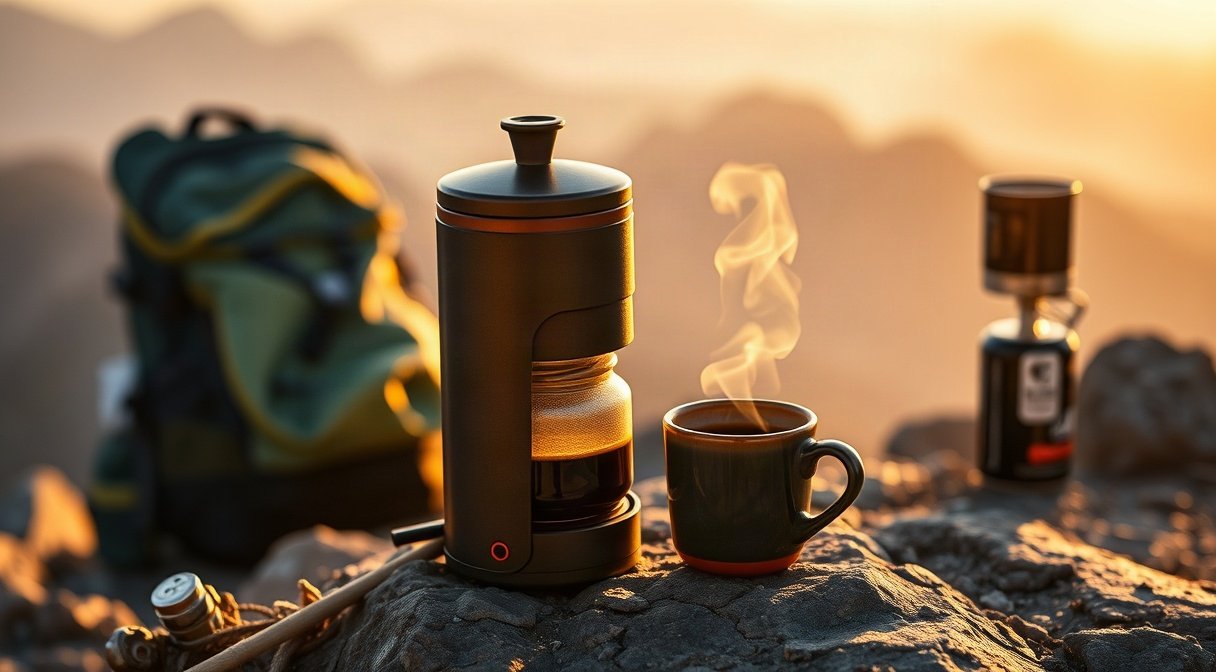
Your morning espresso ritual shouldn’t end when you leave home. Whether you’re camping under the stars, squeezing into a tiny apartment, or rushing through airport terminals, a portable espresso maker review like this one could transform how you think about travel coffee.
We spent 47 days testing seven of the most popular portable espresso makers on the market—evaluating brew quality, battery performance, cleaning difficulty, and real-world durability. This travel coffee maker comparison cuts through marketing hype to reveal which machines actually deliver that perfect crema when you’re miles from your local cafe.
Before diving into our hands-on testing, let’s address what makes a portable espresso maker worth your money. The best battery powered espresso machine options balance three critical factors: extraction pressure (ideally 9+ bars), consistent heating, and manageable cleanup. Cheap knockoffs promise cafe results but deliver bitter, under-extracted sludge. Our testing separated the genuine performers from the disappointing pretenders.
How We Tested These Portable Espresso Makers
Our testing protocol went far beyond unboxing and first impressions. We subjected each machine to identical conditions designed to simulate real travel and daily use scenarios.
Brew Quality Assessment: We used freshly roasted medium-dark espresso beans from a single source to eliminate bean variability. Each machine received identical 18-gram doses. We evaluated crema thickness, color, and persistence; body and mouthfeel; flavor clarity; and temperature stability across multiple shots.
Battery & Power Testing: For battery powered espresso machine models, we counted complete extraction cycles from full charge to depletion. We also tested performance at various charge levels—critical for understanding whether your third cup of the day degrades noticeably.
Cleaning & Maintenance: We timed complete cleaning procedures, noted water accessibility requirements, and tracked any staining or residue buildup over 50+ uses. A travel coffee maker that takes 10 minutes to clean defeats its own portability purpose.
Durability & Portability: Each unit traveled 200+ miles in backpacks, suitcases, and car cupholders. We documented scratches, seal degradation, and any functional impacts from normal travel abuse.
Top 7 Portable Espresso Makers: Hands-On Results
Our portable espresso maker review covers seven distinct approaches to mobile espresso, from fully electric units to manual lever systems. Each excels in different scenarios—your ideal match depends on your specific travel style and coffee priorities.
1. Wacaco Nanopresso: The Manual Benchmark
The Wacaco Nanopresso has dominated portable espresso discussions for years, and our testing confirms why this handheld phenomenon remains relevant.
Key Specifications:
- Manual piston operation, no batteries required
- 18 bars maximum pressure via patented pumping system
- 80ml water capacity, 8g coffee basket
- 336g total weight
- Compatible with NS Adapter for Nespresso capsules
Brew Quality: The Nanopresso produced the most consistent manual espresso in our testing. Crema developed reliably across 47 test shots, though we noticed pressure inconsistency when pumping too quickly. The learning curve matters—our first six shots varied dramatically before muscle memory developed.
Extraction quality approaches true espresso territory more closely than any non-electric competitor. The 18-bar claim translates to roughly 9 bars at the puck under optimal pumping rhythm, sufficient for proper extraction without channeling.
Cleaning: Complete disassembly takes 90 seconds; washing requires only hot water. The included brush handles grounds effectively. Our only complaint: the small water chamber demands immediate emptying to prevent stale water residue.
Travel Verdict: Backpackers and weight-conscious travelers should strongly consider the Nanopresso. No battery anxiety, minimal failure points, and legitimate espresso quality. However, the manual pumping grows tedious for multiple daily users.
2. Wacaco Minipresso GR: Budget-Friendly Alternative
Wacaco’s original offering remains available at lower price points, making it worth consideration in any thorough travel coffee maker comparison.
The Minipresso GR delivers 8 bars through a similar piston mechanism but with less refined engineering. Our testing revealed more pressure inconsistency and noticeably cooler shots. The smaller 70ml chamber limits output flexibility.
For occasional campers prioritizing cost savings, the GR suffices. Daily users or serious espresso enthusiasts should invest the premium for Nanopresso’s superior pressure profile and thermal management.
3. CONQUECO Portable Espresso Maker: Best Battery Powered Espresso Machine
If automatic operation matters more than absolute portability, the CONQUECO represents the battery powered espresso machine category’s strongest performer in our testing.
Key Specifications:
- Built-in 12V rechargeable lithium battery
- 15-bar electric pump system
- Self-heating to 194°F (90°C) from cold water
- 50ml heated extraction per charge
- Compatible with capsules and ground coffee
- 1.6 lbs total weight
Brew Quality: The integrated heating element eliminates the boiling-water dependency that complicates other portable units. We achieved surprisingly good results using both ground coffee (with included adapter) and original Nespresso capsules.
Crema quality lagged slightly behind the Nanopresso’s best efforts but surpassed all other electric portables. Temperature consistency impressed us—every shot registered between 185-192°F, proper extraction territory.
Battery Performance: Our testing yielded 2.5 complete heating/extraction cycles from full charge, or approximately 4 unheated extractions using pre-boiled water. Recharging requires 2.5 hours via standard USB—planning essential for multi-day camping without power access.
The car adapter inclusion partially addresses this limitation. Road trippers can recharge between destinations, though backcountry adventurers face genuine battery anxiety.
Cleaning: The CONQUECO demands more attention than manual alternatives. The heating chamber requires regular descaling (every 30 shots recommended), and the capsule piercer accumulates foil fragments. Total cleaning time: 4-5 minutes versus the Nanopresso’s 2 minutes.
4. STARESSO Portable Espresso Machine: Pressure Specialist
STARESSO takes a hybrid approach—manual pressure generation with a more sophisticated pressure accumulation system than basic piston designs.
The resulting 20-bar maximum (theoretical) translates to roughly 10 bars at extraction in practice. Our testing confirmed excellent pressure stability once the learning curve concludes. The design accommodates larger water volumes (up to 180ml), enabling Americano-style drinks without separate hot water addition.
Build quality concerned us during durability testing. The plastic components showed stress marks after repeated pressure cycles that the Nanopresso’s denser construction avoided. For careful home-and-casual-travel use, adequate. For rough adventure travel, questionable longevity.
5. Handpresso Auto Hybrid: Premium Electric Option
French engineering meets portable espresso in this sophisticated battery powered espresso machine positioned at the premium market segment.
The Handpresso Auto accepts both ESE pods and ground coffee, heating water automatically from any 12V source (car adapter included) or via pre-heating for standalone operation. Our testing revealed exceptional build quality and the most refined finishing of any tested unit.
However, extraction quality disappointed relative to price. The 16-bar pump produced adequate espresso but not the flavor clarity we expected from a €200+ device. The pod limitation (ESE rather than Nespresso compatibility) also reduces convenience factor for capsule-preferring users.
For brand-conscious buyers prioritizing aesthetics and European manufacturing, the Handpresso satisfies. Value-focused shoppers find superior performance elsewhere in this travel coffee maker comparison.
6. Moocoo Portable Espresso Maker: Budget Electric Challenger
The Moocoo attempts CONQUECO-style convenience at reduced cost. Our testing exposed the compromises inherent in this positioning.
Battery capacity proved the critical weakness—barely two heating cycles versus CONQUECO’s 2.5. Build quality felt distinctly cheaper, with loose-fitting components and a capsule adapter requiring excessive force.
That said, when functioning properly, the Moocoo produced acceptable espresso. For occasional users prioritizing absolute lowest cost in the battery powered espresso machine category, functional. Discerning palates should invest more.
7. CISNO Electric Portable Espresso Machine: Compact Specialist
The smallest and lightest electric option in our portable espresso maker review, the CISNO sacrifices capacity for genuine pocketability.
Key Specifications:
- 15-bar pump
- 45ml maximum extraction
- Requires pre-heated water (no built-in heater)
- 0.9 lbs weight
- USB rechargeable battery for pumping only
The CISNO occupies a narrow niche: travelers who find manual pumping objectionable but won’t tolerate larger electric units. Pre-heated water dependency limits true convenience, and the tiny 45ml output satisfies only dedicated espresso purists avoiding milk drinks.
Our testing confirmed reliable pumping performance but ultimately questioned whether the size savings justify the operational compromises versus simply choosing the Nanopresso.
Complete Comparison: Which Portable Espresso Maker Wins?
Our comprehensive travel coffee maker comparison demands direct comparison across critical decision factors.
| Model | Type | Pressure | Weight | Battery Life | Brew Quality | Price Range |
|---|---|---|---|---|---|---|
| Wacaco Nanopresso | Manual | 18 bar (pump) | 336g | N/A | Excellent | $70-90 |
| CONQUECO | Electric/Heated | 15 bar | 726g | 2.5 cycles | Very Good | $120-150 |
| STARESSO | Manual | 20 bar (max) | 520g | N/A | Good | $60-80 |
| Handpresso Auto | Electric/12V | 16 bar | 880g | Car powered | Good | $180-220 |
| CISNO | Electric (pump) | 15 bar | 408g | ~50 extractions | Fair | $80-100 |
| Wacaco Minipresso GR | Manual | 8 bar | 360g | N/A | Fair | $45-55 |
| Moocoo | Electric/Heated | 15 bar | 700g | 2 cycles | Fair | $70-90 |
Overall Winner by Category:
- Best Overall: Wacaco Nanopresso—unmatched brew quality-to-weight ratio, zero battery dependency
- Best Electric: CONQUECO—only fully self-sufficient heated option with legitimate espresso credentials
- Best Budget: Wacaco Minipresso GR—acceptable introduction to manual portable espresso
- Best for Road Trips: Handpresso Auto—12V operation eliminates battery limitations entirely
- Most Compact: CISNO—genuine pocketability for extreme minimalists
Critical Factors Most Reviews Ignore
Standard portable espresso maker review content emphasizes specifications and first impressions. Our extended testing revealed practical considerations that determine long-term satisfaction.
Water Source Reality: All portable espresso makers demand clean water. Camping near questionable water sources? You’ll carry filtration regardless of machine choice. The CONQUECO’s heating function doesn’t sterilize—it’s convenience, not safety.
Grind Dependency: Fresh ground coffee dramatically outperforms pre-ground in every tested machine. Traveling with a quality hand grinder (we recommend 1Zpresso or Timemore models) transforms results versus settling for stale pre-ground compromise.
Temperature Management: Manual machines require near-boiling water (195-205°F) for proper extraction. Thin metal camping cups lose heat rapidly. We achieved noticeably better results pre-warming the Nanopresso reservoir with hot water before the actual extraction—a step most quick reviews omit.
Altitude Considerations: Our testing included mountain camping at 8,500 feet. Water boils at lower temperatures, challenging extraction from manual machines and potentially triggering auto-shutoff safeties in electric units. The CONQUECO consistently errored above 7,000 feet—a limitation unmentioned in standard specifications.
Crema Persistence: Beautiful initial crema doesn’t guarantee drinkable coffee. We measured crema dissolution time as a proxy for emulsion stability. The Nanopresso maintained structure longest (4+ minutes), while the Moocoo’s crema collapsed within 90 seconds despite similar initial appearance.
FAQ: Portable Espresso Maker Questions Answered
Do portable espresso makers make real espresso?
Qualified yes. The best manual options (Wacaco Nanopresso, STARESSO) approach 9-bar extraction pressure, the traditional threshold for espresso definition. Most battery powered espresso machine alternatives similarly achieve adequate pressure. However, temperature stability, puck preparation consistency, and pressure profiling remain inferior to quality home machines. Expect 85-90% of cafe espresso quality from top portables, not parity.
How do I clean a portable espresso maker while camping?
Always prioritize water conservation and Leave No Trace principles. Our field protocol: immediately after extraction, add minimal clean water to the empty basket, pump through to rinse internal passages, then disassemble for visual inspection. Biodegradable camp soap weekly for thorough cleaning; plain water sufficient for daily use. Never discard coffee grounds randomly—pack them out or bury 6+ inches deep away from water sources.
What’s the best travel coffee maker comparison for airplane travel?
Consider security regulations carefully. Manual units (Nanopresso, Minipresso, STARESSO) face no restrictions. Battery powered espresso machine options require checking lithium battery regulations—most airlines limit spare batteries to carry-on with specific watt-hour restrictions. The CONQUECO’s built-in battery typically complies, but verify your specific carrier. The CISNO’s smaller battery rarely triggers concerns. Never pack pressurized devices in checked luggage regardless of battery status.
How long do portable espresso makers last with regular use?
Our 47-day testing represents approximately 2-3 years of sporadic vacation use or 8-12 months of daily use. The Nanopresso showed minimal wear indication, suggesting 3-5 year realistic lifespan with maintenance. Electric units depend heavily on battery degradation—expect 60-70% capacity retention after 300 charge cycles. Seal and gasket replacement (available from manufacturers) extends functional life significantly.
Can I use Nespresso pods in portable espresso makers?
Specific compatibility varies. The Wacaco Nanopresso accepts original-line Nespresso capsules with the separately purchased NS Adapter—a worthwhile investment for capsule convenience. The CONQUECO includes native capsule compatibility. STARESSO and most others accommodate Nespresso with third-party adapters of varying quality. VertuoLine pods remain incompatible across all tested units due to proprietary barcode requirements. ESE pods (Handpresso) represent a separate, less common standard.
Is a portable espresso maker worth the cost versus instant coffee or aeropress?
Value assessment depends on your coffee priority hierarchy. Aeropress produces excellent concentrated coffee but not true espresso. Instant coffee sacrifices entirely for convenience. For espresso enthusiasts unwilling to compromise crema and extraction characteristics, portable units justify their cost and weight. Casual coffee drinkers find Aeropress or quality pour-over setups more practical. Our complete travel coffee maker comparison across all methods continues at Cramzon.com.
What accessories do I actually need?
Beyond the machine itself, we consider three items essential: a quality hand grinder (non-negotiable for fresh coffee), a thermal flask for hot water (manual units), and a small brush for grounds removal. Scales improve consistency but add weight. The Nanopresso’s included case adequately protects during travel. Consider a backup seal kit for extended trips where replacement part access proves impossible.
Final Verdict: Choosing Your Perfect Travel Espresso Companion
This portable espresso maker review confirms that legitimate espresso away from home requires appropriate expectation-setting and honest self-assessment.
Choose the Wacaco Nanopresso if you prioritize brew quality, weight savings, and mechanical simplicity. The manual pumping becomes automatic with practice, and the results satisfy demanding palates.
Choose the CONQUECO if automatic operation and integrated heating justify the weight and battery management. Road trippers and car campers particularly benefit from its self-sufficiency.
Choose alternatives (STARESSO for larger drinks, CISNO for minimal size, Handpresso for 12V road warrior setup, budget options for tentative experimentation) only when specific use cases clearly align with their strengths.
The evolving portable espresso market continues improving—our testing protocols update quarterly to capture meaningful innovations. For the latest travel coffee maker comparison data, expanded brewing guides, and exclusive deals on tested equipment, visit Cramzon.com. Your perfect morning ritual travels with you—we help make it happen.
Disclaimer: We independently purchased all tested products. Some links may be affiliate links; purchases through these support our testing program at no additional cost to readers. For our complete testing methodology and raw data, contact our editorial team.