
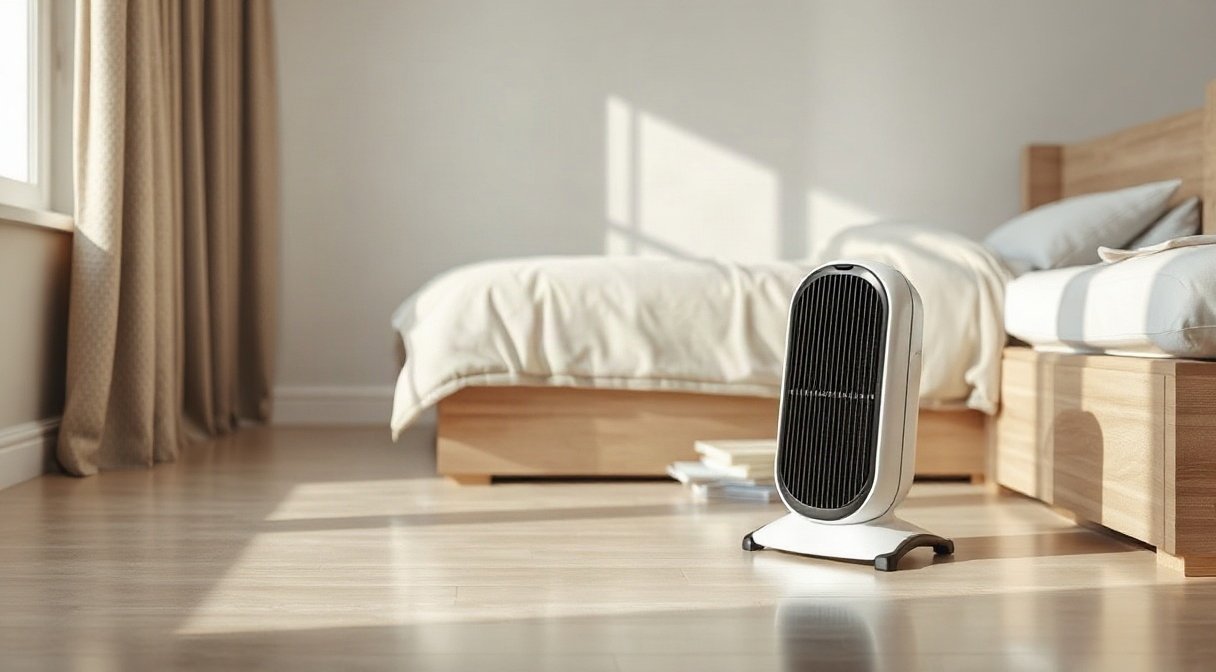
A bedroom heater needs to do more than produce warmth. It should let you manage temperature without constant fiddling, run quietly enough for sleep and include safety features suited to its placement. This guide compares five ceramic options and explains what to check before choosing a ceramic space heater safe bedroom users can operate responsibly.
There is an important limit to any electric resistance heater: nearly all the electricity it uses becomes heat, so a high wattage setting does not magically heat a room more efficiently. Savings come from heating only the space you occupy, choosing a suitable output, using a thermostat sensibly and switching the heater off when it is not needed. Product specifications and safety equipment can vary by model and region, so confirm the exact version available to you.
Five Ceramic Space Heater Picks for Bedroom Use
These models represent different bedroom needs rather than a universal ranking. Availability, controls and safety features can differ between product revisions and regional versions. Check the manufacturer’s current manual and product label before buying. This comparison focuses on the practical trade-offs shoppers should weigh when looking for a ceramic space heater safe bedroom use can accommodate.
| Heater | Best suited to | Thermostat and controls | Main trade-off |
|---|---|---|---|
| Dreo Atom One series | Small to medium rooms and adjustable comfort | Digital controls; settings vary by version | More controls mean more to configure |
| Lasko 754200 | Simple, compact spot heating | Manual dial thermostat | Basic operation, without digital scheduling |
| Lasko 755320 tower | Wider heat distribution and convenience | Digital controls and remote on listed versions | Taller footprint and more features to manage |
| Honeywell UberHeat HCE200 | Personal warmth near a desk or bedside area | Manual controls; confirm version details | Less useful for spreading heat widely |
| De’Longhi Capsule HFX30C18 | UK shoppers wanting a compact local model | Mechanical controls; check exact variant | Not directly comparable to US-voltage models |
Dreo Atom One: a feature-rich all-rounder
The Atom One family is a good place to start if you want a compact heater with a digital interface and more precise temperature selection than a simple dial can offer. Depending on the exact version, features may include multiple heat modes, a thermostat, a timer, oscillation or a remote. Its strengths are flexible operation and the ability to direct warmth across more than one spot. The compromises are a busier control set and the need to check which features are included in the particular listing. It may not suit someone who wants the simplest possible manual appliance or who expects a small heater to warm an entire large bedroom evenly.
Lasko 754200: uncomplicated spot heating
This compact ceramic model is known for straightforward, manual operation. A dial-based thermostat and limited controls can be an advantage when all you need is occasional heat near a chair or one side of a small room. It is generally a budget-oriented choice, but it lacks the convenience of a digital temperature display or remote control. Verify the exact revision’s safety features rather than assuming they match a newer heater. Choose something else if you need precise scheduling, room-wide circulation or easy adjustment from bed.
Lasko 755320 tower: more reach and convenience
A tower format and controls such as a remote, timer or oscillation on listed versions can make this model more convenient when warmth needs to reach across a bedroom. It takes up a different kind of floor space than a squat personal heater, and the added controls may be unnecessary for a bedside spot-heating job. Confirm the control and protection details in the manual for the version you are considering. It is not the best fit for a cramped floor plan where a stable, unobstructed position is hard to maintain.
Honeywell UberHeat and De’Longhi Capsule: compact alternatives
The UberHeat is a compact option for localized warmth; its small form is useful, but it should not be mistaken for a whole-room heating system. The De’Longhi Capsule is a regional alternative for UK buyers, with a compact design suited to supplemental heating. Look up the exact HFX30C18 variant and its instructions before purchase. Neither is ideal if your priority is sophisticated programming, and US shoppers should not buy a UK heater simply because the plug adapter seems convenient.
Energy Efficiency and Thermostat Features That Matter
When comparing an energy efficient space heater small room shoppers can actually use well, separate electrical efficiency from practical savings. A ceramic element heats quickly, but ceramic construction alone does not guarantee lower energy use than another electric resistance heater. At the same heat output, electric resistance models convert nearly all incoming electricity into heat. The real opportunity is to avoid heating unused space or running the appliance longer than necessary.
For context, a common US portable heater uses up to 1,500 watts on its high setting. Many UK ceramic models operate on a 220–240-volt supply and may have a different rated output. Use the rating plate and manual for the exact model, not a number copied from a product with a similar name. If you want to estimate operating cost, multiply the heater’s kilowatts by hours used, then by your electricity tariff. That estimate is not a promise of savings: room insulation, thermostat cycling and local energy rates all affect the result.
Choose a useful thermostat, not just a heater with a dial
A thermostat helps maintain a chosen temperature by switching the heating element on and off as conditions change. A digital thermostat can make a setting easier to repeat, while a manual dial may be less precise and may not show the actual room temperature. Neither should be treated as a precision climate-control instrument. Place the unit where its intake and temperature sensor are not blocked, and expect performance to be affected by cold drafts, nearby walls and the heater’s own warm airflow.
- Digital temperature setting: useful if you want repeatable adjustments, but check the displayed range and increments.
- Eco or automatic mode: can vary power or cycle heat to meet a target; read the manual to understand its behavior.
- Timer: helps limit operation, but a timer is not a substitute for safe placement or supervision.
- Manual thermostat: simple and often adequate for occasional use, though it may take trial and error to find a comfortable position.
In this space heater with thermostat review, the key distinction is usability. If you regularly change the setting, digital controls may make responsible operation easier. If you only need brief warmth while getting dressed, a basic dial may be enough. Avoid raising the setting in the belief that the heater will warm the room more efficiently; it generally calls for more heat before switching off, rather than heating the room faster.
Insulation and room size can matter as much as the heater. Close doors to the space you intend to warm, use curtains appropriately and address drafts where possible. A small heater may struggle in a large, poorly insulated room, leading to long run times without comfortable warmth. Use a permanently installed heating system when it is the safer or more suitable solution. Treat portable heating as supplemental, and check your electricity provider’s tariff if running cost is a concern.
Quiet Operation: What to Expect in a Bedroom
“Quiet” is not the same as silent. Ceramic heaters with a fan need airflow to move warmth away from the heating element, so most produce some sound. A low fan setting may be unobtrusive to one sleeper and distracting to another. Published noise claims are difficult to compare unless the measuring distance, room conditions and operating mode are the same. If you are sensitive to sound, look for a clear noise specification from the manufacturer and, where possible, assess the heater in person or check credible owner feedback for comments about fan pitch and cycling.
Fan design and speed can matter more than the heater’s shape. A compact personal unit may create a close stream of warm air, while a tower with oscillation can distribute it more widely. Oscillation can improve perceived coverage, but it adds movement and may introduce a sound of its own. A digital unit may also beep when you change a setting. Check whether the beeps can be muted if you plan to make adjustments after going to bed.
Match the controls to your sleep habits
If you use heat only while getting ready for bed, a basic heater that you switch off before sleep can be a sensible, simple approach. For people who rely on a timer, make sure the timer works as expected and do not assume that a delayed start or remote feature is safe for every overnight scenario. Follow the manufacturer’s instructions about unattended operation. If the manual says not to leave the appliance running while you sleep, respect that warning even if the heater has a thermostat or automatic shutoff.
- Try the heater at the lowest effective setting before deciding that its fan is too loud.
- Keep it away from curtains, bedding and clothing; moving fabric can obstruct air inlets or outlets.
- Place it on a firm, level floor, not on a mattress, bed, soft rug or unstable furniture.
- Do not use a heater’s warm airflow as a reason to position it close to your face or bedding.
- Check whether oscillation, display lights or control beeps can be disabled for nighttime comfort.
For a light sleeper, a quiet low setting and a stable thermostat may be more useful than a long list of smart functions. A heater that cycles on and off can still be audible, and some people notice the change in fan sound more than a steady low hum. Try to warm the room before bedtime, then switch the appliance off if the instructions require it. If you need continuous heat throughout the night, consider whether your home’s fixed heating system is more appropriate.
When comparing a ceramic space heater safe bedroom shoppers might shortlist, do not rely on a product title that calls it whisper-quiet. Look for the stated sound level and the conditions under which it was measured, then balance that information with the fan’s tone, controls and your own sensitivity. No noise rating can establish safety. Quietness is a comfort feature, not permission to place a heater near bedding or leave it operating against its instructions.
Ceramic Space Heater Safe Bedroom: Essential Safety Rules
A ceramic space heater safe bedroom setup depends at least as much on placement and habits as on the product. A tip-over switch or overheat protection can reduce certain risks, but no portable electric heater is risk-free. Read the manual for your exact model, follow local electrical guidance and use the appliance only as its manufacturer permits. Safety claims can vary between revisions, so verify them in the official specifications rather than relying on an old listing or a retailer’s short description.
Set up a clear, stable heating area
Put the heater on a level, solid floor with the clearances specified in the manual. Keep it well away from beds, blankets, curtains, clothes, furniture and paper. Never cover the heater or use it to dry laundry. Do not place it where someone could knock it over while walking, where a door can hit it, or where a pet could pull at its cord. Keep children and pets at a safe distance, and use any guard or safety instructions supplied by the maker.
Use the correct outlet and inspect the cord
Plug the heater directly into a suitable wall outlet unless its manufacturer explicitly states otherwise. Avoid extension cords, multi-plug adapters and power strips unless the manual and qualified local guidance specifically permit their use. High-power heaters can place a substantial load on household circuits. Do not run the cord under rugs, across walkways or beneath furniture, and stop using the heater if the plug, outlet or cable becomes unusually hot, damaged or discoloured. If an outlet feels loose or shows signs of damage, have it checked by a qualified electrician.
In the US, use a heater designed for the local electrical supply and follow the product’s grounded or polarized plug requirements. In the UK, choose a model intended for the UK market, with its correct plug and rating. Do not treat a travel adapter or plug converter as a safe way to operate a heater made for a different voltage. Voltage, frequency, plug design and the appliance’s certified protections all matter.
Understand protection features—and their limits
Overheat protection may shut a unit down if its temperature rises beyond a designed limit. A tip-over switch may interrupt operation if the heater falls. These features are useful layers, not a guarantee against fire or burns. Check which protections are listed for the exact model, keep air openings clear and do not bypass a safety device. A cool-touch exterior claim does not mean every surface, grille or outlet air stream is safe to touch.
Use smoke alarms as part of a broader home-safety plan and maintain them according to local guidance. Stop operation if the heater smells unusual, sparks, makes a new grinding noise or repeatedly trips a breaker. Unplug it only if you can do so safely, then contact the manufacturer or a qualified professional as appropriate. Do not open or repair a mains-powered heater yourself unless you are qualified and the manufacturer permits the work.
One of the most important bedroom rules is to follow the manual’s guidance on sleeping and unattended use. Some users assume a thermostat makes overnight operation safe; it does not remove risks from nearby fabric, a damaged cord or a blocked intake. If the manufacturer says not to leave the heater on while asleep or away, switch it off. This is a core part of choosing a ceramic space heater safe bedroom occupants can use responsibly, not an optional extra.
US and UK Buying Guide, FAQs, and Final Checks
For US shoppers, a 120-volt model designed for the US market is the straightforward choice. Many common portable heaters are rated up to 1,500 watts, but confirm the label and consider the capacity of the circuit they will share. For UK shoppers, select a heater built for 220–240-volt domestic supply and sold with the appropriate UK plug. The De’Longhi Capsule is a local-market option to investigate, while US Lasko and Honeywell models should not be assumed compatible with UK mains. The reverse is also true: a UK appliance is not automatically suitable for US use.
Before buying, check the exact model number, operating modes, thermostat type, timer behavior, stated safety protections, noise information and warranty terms. Read the current manual, especially its clearance requirements and rules for overnight use. For a compact bedroom, prioritize stable placement and convenient controls over maximum output. If heating a room consistently requires a portable heater to run for long periods, review the room’s insulation and consider advice about fixed heating rather than simply choosing a larger appliance.
Frequently Asked Questions
Is a ceramic space heater safe to use in a bedroom?
It can be used responsibly when the model is appropriate, placed according to its manual and operated with required clearances. Keep it away from bedding and curtains, plug it in as directed and follow all instructions about sleep and unattended operation. Safety features do not eliminate risk.
Can I leave a ceramic heater on while I sleep?
Follow the manufacturer’s instructions for the exact heater. If its manual says not to leave it running while asleep, switch it off before bed. A thermostat, timer or tip-over switch does not override that warning or make unsafe placement acceptable.
Do ceramic heaters use less electricity?
Not simply because the heating element is ceramic. Electric resistance heaters convert nearly all electricity they use into heat. You can reduce unnecessary consumption by heating a smaller occupied space, selecting a suitable setting and using thermostat or timer controls as instructed.
What is the quietest ceramic heater for a bedroom?
There is no single quietest choice for every sleeper. Fan speed, sound pitch and cycling behavior affect comfort. Compare manufacturer noise information where available, check the operating mode it describes and consider whether the display or control beeps can be turned off.
Can I use a US heater in the UK with a plug adapter?
Do not assume that a plug adapter makes a heater compatible. US and UK supplies differ in voltage, and a heater must be designed for the local electrical system. Buy a locally rated model and follow its manual and plug requirements.
In this space heater with thermostat review, the best match is the heater whose controls, coverage and noise suit your routine—not necessarily the one with the most modes. The Dreo is worth considering for flexible controls, the compact Lasko 754200 for simple spot heating, and the tower format for broader perceived distribution. UK shoppers should prioritize a locally rated option such as the appropriate De’Longhi variant. Always check current specifications before ordering.
Conclusion: Choose Comfort Without Skipping Safety
A good bedroom heater should suit the room, be easy to control and fit your tolerance for fan noise. Thermostats and timers can support more deliberate use, but they do not guarantee lower bills or safe overnight operation. Confirm voltage and product protections, maintain clear space around the heater and follow its manual. For more practical buying guides and product comparisons, visit darkred-shrew-449174.hostingersite.com and compare the details before you buy.